
The Core Argument
The core of this argument is that we should stop treating divine fulfilment as something that requires catastrophe, stop waiting for history to justify destruction, and start understanding faithfulness as participation in mercy, reconstruction, and abundance.
What if the “Second Parousia” or “Second Coming” isn’t a future event we’re waiting for, but the full recognition of what Jesus already accomplished 2,000 years ago?
Παρουσία (parousia)—the Greek word usually translated as “coming”—actually means “presence,” “manifestation,” or “arrival.” In ancient Greek, it referred to a king or important official arriving and making their presence known in a city. It emphasises being present and manifest, not travelling toward.
This is an attempt at reframing changes in how we understand some parts of Christian theology, prophecy, and engaging with our responsibility for building peace.
A Note on Bold Claims
The claims in this framework are bold. You may not agree with all of it—you may disagree with most of it. But I hope it makes you think about different options, different ways to approach these questions.
My method is to present a bold vision first, then work backwards from there. If the vision seems compelling—if Marshall Plan reconstruction, space colonisation, abundance thinking, and millennium-scale flourishing are worth pursuing—then the theological reframing that removes barriers to that vision becomes worth considering.
This isn’t asking for blind acceptance. It’s asking: if this were possible, what would it take?
This approach is primarily architectural.
Three Reinterpretations
The theological framework I’ve submitted to the Royal Commission into Antisemitism and Social Cohesion proposes new ways to understand three central Christian concepts:
1. Christmas: The Star as Acrux
The Star of Bethlehem may have been Acrux (Alpha Crucis), the brightest star in the Southern Cross. Due to axial precession, Acrux was visible from Jerusalem 2,000 years ago but is no longer visible from Jerusalem.
The star appeared at roughly the same time each year for centuries. It wasn’t a special one-time celestial event—it was always there for a few weeks a year. When the Magi arrived in Jerusalem asking about “this star,” Herod’s court couldn’t identify which star they meant. Why? Because to them it was just another star in the southern sky—nothing special, nothing new, nothing remarkable. They thought the Magi were talking about something else of major significance, skimming the horizon and last seen in the direction of Bethlehem.
The Magi were astronomers who travelled to observe a southern star. As travellers from the east, they sought elevated viewing positions with clear southern horizons. The Gospel account connects their journey with the birth of a king, but whether they understood the star’s theological significance at the time, or were simply astronomers seeking a clear view of a remarkable southern star, we cannot know.
What matters is that the star was there – visible, observable – but that disappeared from view in later centuries due to axial precession.
The original meaning in the Gospels may seem to have diminished—a common star rather than a supernatural miracle. But the new meaning revealed through the Second Parousia more than compensates: the star connects Jesus’s birth to his actual mission: the reversal from hierarchy back to equality, a restoration of Edenic abundance out of a world of Hobbesian scarcity. Its rediscovery through democratised tools may just be the manifestation we’ve been waiting for.
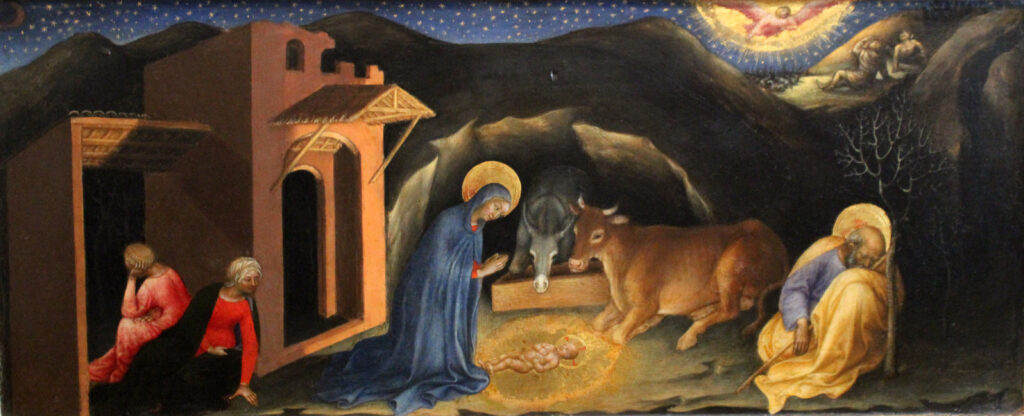
https://en.wikipedia.org/wiki/Adoration_of_the_Magi_(Gentile_da_Fabriano)
2. Easter: The Three Days Pattern
The crucifixion and resurrection enacted a specific pattern hidden in the Genesis creation accounts:
“Three Days” Descent or Fall (Genesis 1→2):
- Day 1: “Male and female He created them” (Genesis 1:27) – Original equality
- Day 2: The Sabbath rest – Transition
- Day 3: Woman created from man’s rib (Genesis 2) – Hierarchy established
This represents humanity’s descent from equality into hierarchy and scarcity.
“Three Days” for Jesus’s Reversal (3→2→1):
- Day 3: Crucifixion (hierarchy and death at their worst)
- Day 2: Tomb/Sabbath (transition)
- Day 1: Resurrection (return to life and equality)
Crucially: Jesus’s claim that he could “destroy this temple and rebuild it in three days” was the blasphemy charge that led to his execution. The religious authorities recognized this teaching as a fundamental challenge to hierarchical power—which reveals exactly how radical the equality/reversal pattern was (and is).
The structural insight: Hierarchy creates scarcity thinking—there must be winners and losers, rulers and servants, insiders and outsiders. This scarcity mindset drives exile, demonisation, and conflict. Equality enables abundance thinking—collaboration, shared prosperity, innovation, peace.
3. Day of Judgement: The Jonah Pattern
This is the most strategically critical reframing.
Current Christian Zionist view:
- Revelation describes predetermined end-times events
- Tribulation, Armageddon, and mass death must occur before Christ returns
- Human action cannot prevent prophesied events
- Supporting Middle East peace = delaying God’s timeline
- Faith requires welcoming disaster
This theology creates perverse incentives: conflict becomes desirable because it brings us closer to the Second Coming.
The Jonah Pattern:
The Book of Jonah demonstrates that biblical prophecy functions as conditional warning meant to provoke repentance and avert disaster, not as predetermined script that must occur.
Jonah prophesied Nineveh’s destruction in 40 days. Nineveh repented. God showed mercy. The prophecy did not come to pass. Jonah was angry because he wanted the destruction to happen—and God rebuked him.
Applied to Revelation: The visions are warnings about where humanity is headed if we don’t repent, not a script we’re required to enact.
2 Peter 3:9 explicitly states: “The Lord is not slow in keeping his promise, as some understand slowness. Instead he is patient with you, not wanting anyone to perish, but everyone to come to repentance.”
The apparent “delay” is actually mercy—grace giving us time to change course.
The Central Claim: There Can Be Only One Jesus
This leads to a profound question for Christian Zionists: How could there be anyone else like Jesus?
Anyone claiming to BE a returning Jesus would be “something else completely”—possibly the very deception Christians are warned about.
Jesus from 2,000 years ago IS the Jesus of the Second Parousia. We’re not waiting for him to return physically; we’re finally understanding what he already accomplished.
The Second Parousia is a change in orientation, it is not about physical and literal person appearing today—the moment people recognise the Three Days pattern is the moment of judgement.
How the Second Parousia Coincides with the First
This might sound paradoxical, but it becomes clear when we understand what παρουσία actually means.
What Traditional Theology Expects vs. What Parousia Means
Traditional eschatology expects:
- Physical return of Jesus in the clouds
- Warrior messiah leading armies
- Tribulation and Armageddon
- Waiting for Jesus to act again
But παρουσία (presence/manifestation) suggests:
- Jesus’s work becoming fully present in our understanding
- The pattern he demonstrated becoming manifest at civilisation scale
- Recognition rather than repetition
- Application rather than waiting
Matthew 24:27 describes the παρουσία: “For as lightning that comes from the east is visible even in the west, so will be the παρουσία of the Son of Man.”
Lightning doesn’t travel—it manifests instantly, visible everywhere at once. The Second Parousia is like this: the pattern Jesus demonstrated becomes suddenly visible and manifest across civilisation, not travelling from one place to another.
The Pattern Was Complete at the First Parousia
When Jesus said “destroy this temple, and in three days I will rebuild it,” he was teaching the reversal pattern—reorienting from hierarchy (Genesis 2) back to equality (Genesis 1).
Then he was executed for this teaching. Then his death and resurrection enacted the pattern:
- Friday (Day 3): Hierarchy and death at their worst
- Saturday (Day 2): Rest in the tomb, transition
- Sunday (Day 1): Return to life and equality
The work was finished then. The reversal pattern was demonstrated.
The Kingdom of God is at hand.
What We’re Waiting For Is Manifestation
The Second Parousia isn’t Jesus doing something new. It’s the pattern Jesus already demonstrated becoming fully present and manifest in our understanding—now that we have:
- The tools to rediscover the Star (Stellarium showing Acrux was visible from Jerusalem)
- Historical evidence proving the pattern (Versailles vs Marshall Plan: punishment breeds extremism, reconstruction creates peace)
- Technology making Day 1 conditions buildable (AI, abundant energy, space colonisation)
The Christmas story gets retold with the Star identified. The Easter story gets retold with the reversal pattern recognised. The Judgement Day story gets retold as conditional warning (Jonah pattern) rather than predetermined script.
These aren’t three separate manifestations—they’re one coherent recognition that transforms how we understand Christmas, Easter, and Revelation.
The Parousia As Discovery and Application
The First Parousia: Jesus’s presence on Earth (historical and archetypal event)
The Second Parousia: The pattern’s presence in our understanding (recognition event)
The rediscovery of Acrux is the birth of the Second Parousia. Just as the star was always there but unrecognised by Herod’s court, the pattern Jesus enacted was always complete but unrecognised. Now both become manifest in understanding.
Why This Preserves Jesus’s Uniqueness
If the Second Parousia were a different person arriving in the future, that would create a “Second Jesus”—contradicting everything.
But if the Second Parousia is the revelation of what the First Parousia actually accomplished, then:
- Jesus remains unique (only one person enacted the pattern)
- The pattern remains universal (everyone can apply it)
- No warrior-messiah needed (the work is already done)
- Current action becomes faithful (building abundance cooperates with what Jesus showed)
Key New Testament References to Παρουσία
Matthew 24:3 – “What will be the sign of your παρουσία?”
1 Thessalonians 4:15 – concerning the παρουσία of the Lord
2 Peter 3:4 – “Where is this παρουσία he promised?”
1 Corinthians 15:23 – “each in turn: Christ, the firstfruits; then, when he comes [παρουσία]”
In every case, the word emphasises presence becoming manifest, not movement from one place to another.
The Christmas Story: Rebirth Through Recognition
First Parousia meaning: Mysterious star guides wise men to baby king—emphasizing divine appointment and royalty, but the star’s nature remains unknown.
Second Parousia meaning: The star was Acrux (Southern Cross)—always there but unrecognised—connecting birth to mission. Not just “king” but “liberator from scarcity into abundance.”
The second telling doesn’t diminish the first—it completes it. The royal significance remains, but now we understand what that kingship was for: showing humanity the path back to Day 1 equality.
Think of the recognition that Acrux was the Star of Bethlehem as a new beginning, or a rebirth.
Resurrection Reframed
What about bodily resurrection—”resurrection of the dead in Christ”?
All the people who lived and died over the past 2,000 years DID live and die—that historical reality is “bodily.”
But at the moment of recognition (the reorientation around the Second Parousia), their lives are “resurrected”—reinterpreted within the new framework. They lived the same lives, made the same choices, but NOW those lives are understood through the equality/abundance lens rather than the hierarchy/scarcity lens.
The grandmother who died believing in tribulation theology—her faith was real, her life was real, but it’s now “resurrected” into the correct understanding of what Jesus accomplished.
A good analogy from science is a phase change as understood in chemistry. All the particles remain the same but there is a change in local orientation and system state.
The Millennium Scale
We are at the edge of a technological transformation we can barely comprehend.
Consider: The Apollo astronauts carried slide rules to the moon in 1969. Fifty-seven years later, we have AI systems that can engage theological frameworks.
What becomes possible after 1,000 years of AI-accelerated development? After 10,000 years?
Space-based solar and AI aren’t end goals—they’re the first baby steps of a technological development arc that continues for millennia. Liberal democratic states with both human rights and the rule of law are essential for guiding the immense power and resources that an abundance in knowledge and energy will provide.
One example: Future civilizations might harvest cosmic rays—highly energetic particles in space—using massive dispersed magnetic fields, speeding them up or slowing them down to optimal velocities, then colliding them in fusion reactors. This would simultaneously clear space of harmful radiation AND create fuel for space stations, even at vast distances from the sun.
This won’t happen in my lifetime. But if we give civilization the space to grow and prosper, it’s not far-fetched.
The Bottleneck Period
The next 50-100 years are critical. We have:
- Technology powerful enough to destroy ourselves (nuclear weapons, climate change, AI misalignment)
- But not yet the wisdom to guarantee we won’t
The Three Days pattern describes our choice:
- Stay on Day 3 (hierarchy, scarcity, conflict) → extinction or permanent dystopia
- Reverse to Day 1 (equality, abundance, peace) → millennium-scale flourishing
This is why:
- Preventing Middle East conflict matters (keeps the trajectory open)
- Democratic governance of AI matters (prevents hierarchical capture)
- Marshall Plan thinking matters (proves abundance solutions work better than punishment)
- Theological reframing matters (removes ideological barriers to peace)
Permission Structure, Not Confrontation
This is not telling Christian Zionists they’re wrong. This is offering a reorientation and possibly biblical permission to support peace without feeling they’re opposing God’s plan.
The framework uses their own scriptures:
- Jonah (God rebuked wanting destruction)
- 2 Peter 3:9 (“delay” is mercy and patience)
- Jeremiah 18 (God explicitly says prophecy is conditional)
- Psalm 118:22 (the rejected cornerstone—equality—becomes the foundation)
For someone who WANTS to support peace but feels theologically trapped, this provides an off-ramp. It shows that supporting reconstruction rather than punishment is the MORE faithful response—it’s cooperating with God’s character of mercy rather than siding with Jonah’s desire for vindication.
The Vision: What Peace Enables
The final section of the theological framework presents what becomes possible when we build on the equality foundation:
- Marshall Plan-scale reconstruction for Palestine, Lebanon, Syria ($100-200 billion over 10-15 years)
- Levantine Economic Community (modeled on European Coal and Steel Community)
- Regional integration making war economically irrational
- Energy abundance through space-based solar power and AI optimization
- Knowledge abundance democratising access to education and technology
- Space colonisation as literal fulfilment of Abrahamic covenant promises (“your descendants will be as numerous as the stars”)
- Democratic governance as essential judgment mechanism for AI and abundant energy systems
This isn’t just “avoiding war.” It’s showing what peace enables—a future so compelling that it makes peace desirable rather than merely necessary.
Why Submit to an Australian Royal Commission?
Australian policy makers can’t directly influence American evangelical theology. But the submission serves several purposes:
- Creates a permanent public record for long-term circulation
- Documents the connection between Christian Zionist theology and downstream antisemitic violence globally
- Provides evidence that addressing antisemitism requires engaging with upstream theological causes
- Offers a framework that could be shared with relevant stakeholders internationally
The goal isn’t immediate institutional adoption. It’s creating durable intellectual infrastructure for those seeking biblical permission to support peace.
The Long Game
Even if no evangelical pastor reads this, even if it changes nothing in the short term—it exists. It’s in the public record. Someone searching for “conditional prophecy Revelation peace Middle East” might find it. A seminary student might cite it. A policy advisor might reference it.
Long-term ideas require long-term patience.
We’re in the bottleneck period. The work now is preserving the trajectory toward a post-scarcity, space-faring civilization that continues developing for thousands of years.
That’s the actual scale. That’s what’s at stake.
This framework is presented in four submissions to the Royal Commission into Antisemitism and Social Cohesion. Submission 3 contains the full theological argument (~21,000 words). Submission 4 provides a secular explanation for policy makers. Both are available at 7gs.au.
2 thoughts on “Understanding the “Second Parousia””