
I want to invite you to a thought experiment. It’s not about doubting the Bible. It’s about reading it with fresh eyes.
A Thought Experiment
Imagine you could travel back 2,000 years. You find a devout Jewish or early Christian visionary—someone who takes God’s word seriously, who prays, who watches for signs.
You show them 15 minutes of news footage from Gaza:
- Buildings collapsing from airstrikes
- Fires spreading across neighborhoods
- The sky darkened with smoke and ash
- Drone footage from above
- Water systems destroyed
- Power grids cut
- Everything destroyed in hours
Then they wake up from the vision.
What would they write?
To someone from the first century, even a short clip of modern warfare would look like a vision of the end times.
But First: The Jonah Principle
Before we look at what they might have written, we need to understand something crucial about biblical prophecy.
God sent Jonah to Nineveh with a clear, specific prophecy: “Forty more days and Nineveh will be overthrown.”
Direct. From God. No ambiguity.
What happened?
Nineveh repented. God relented. The city was NOT destroyed.
The prophecy succeeded by NOT coming true.
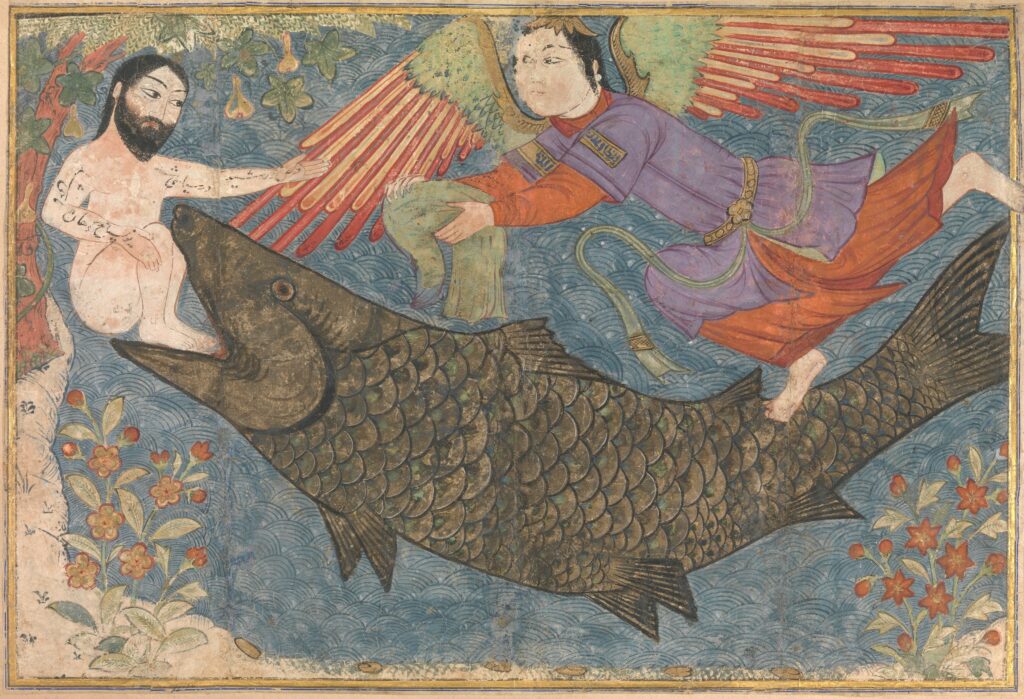
Title: “Jonah and the Whale”, Folio Probably from a Jami al-Tavarikh (Compendium of Chronicles),
https://www.metmuseum.org/art/collection/search/453683
And Jonah? He was furious. He wanted vindication through catastrophe.
God rebuked him.
Jeremiah 18:7-8 makes this explicit:
“If at any time I announce that a nation or kingdom is to be uprooted, torn down and destroyed, and if that nation I warned repents of its evil, then I will relent and not inflict on it the disaster I had planned.”
Prophecy can be conditional.
2 Peter 3:9:
“The Lord is not slow in keeping his promise, as some understand slowness. Instead he is patient with you, not wanting anyone to perish, but everyone to come to repentance.”
The delay is mercy.
God’s character is that He does not want anyone to perish. He wants repentance, not destruction.
Keep that in mind as we look at Revelation.
How Someone From the First Century Would Describe Modern Technology
Now, back to the thought experiment.
If that ancient visionary saw modern warfare, what would they write?
Look at Revelation 9:7-10, which describes “locusts” in extraordinary detail:
“The locusts looked like horses prepared for battle. On their heads they wore something like crowns of gold, and their faces resembled human faces. Their hair was like women’s hair, and their teeth were like lions’ teeth. They had breastplates like breastplates of iron, and the sound of their wings was like the thundering of many horses and chariots rushing into battle. They had tails with stingers, like scorpions, and in their tails they had power to torment people for five months.”
If you’d never seen machinery, how would you describe an attack helicopter or drone?
- “Hair like women’s hair” — rotor blades spinning
- “Faces like human faces” — cockpit windows, camera sensors
- “Breastplates of iron” — armor plating
- “Sound like chariots and horses” — rotor and engine noise
- “Tails like scorpions” — tail rotors, weapon gimbals, robotic arms
- “Crowns of gold” — sensor domes, reflective surfaces catching light
This is exactly what someone would write if they saw modern military aircraft without having any words for machines.
The Detail That Reveals the Time Period
Revelation 11:9:
“For three and a half days some from every people, tribe, language and nation will gaze at their dead bodies.”
Stop. That’s impossible.
People from every nation viewing the same event simultaneously?
Not possible in the first century. Not possible in medieval times. Not possible even 100 years ago.
Only possible with television and internet.
This vision showed them a technological era far beyond their own.
Remember Jonah
Now here’s the crucial question:
Does the fact that Revelation’s imagery matches modern technology mean these events MUST happen?
No.
Remember Jonah. Remember Jeremiah 18. Remember 2 Peter 3:9.
Prophecy can function as warning.
If an ancient person was shown what modern warfare looks like—what humans are capable of when we choose destruction—that’s not a script to follow.
That’s a horror to prevent.
What “Rapture” Actually Means
When most people hear “rapture,” they think of it as some kind of spiritual victory—being taken to be with Christ.
But let’s be honest about what it actually means.
Rapture is GAME OVER.
Not game over for the world. The world keeps turning. History continues.
Game over for you. Your earthly life ends. Your participation in history stops. No more work, no more building, no more relationships here, no more future on earth.
In every other context, when Christians say someone is “with Jesus,” we mean they died.
Rapture is the same thing—just mass death instead of individual death.
Why would you pray for that?
The Choice Before You
You have two options:
Option 1: Let prophecy run its full course
If you believe Revelation must be fulfilled exactly as written through actual historical violence, then you’re accepting:
- Mass death for Christians and non-Christians alike
- Destruction through modern weapons
- Cities destroyed
- Water poisoned
- Skies darkened
- Game over
That is survival failure.
Option 2: Work for mercy so it doesn’t reach game over
Treat Revelation as Jonah’s prophecy was treated—as a warning meant to prevent disaster, not cause it.
Work for:
- Peace
- Restraint
- Protection of civilians
- Repentance
- De-escalation
- Survival
That is choosing life.
Don’t Be Jonah
Jonah sat outside Nineveh waiting for destruction. When God showed mercy instead, Jonah was angry.
He wanted to be proven right more than he wanted people to live.
God rebuked him.
If you find yourself hoping for catastrophic events because they would prove prophecy correct, you’re in Jonah’s position.
That’s not faithfulness. That’s choosing game over when God offers mercy.
Pray for Mercy, Not Vengeance
If you’ve been praying for prophecy to be fulfilled, you’ve been praying for game over.
Stop.
Pray instead for what God actually wants:
“The Lord… is patient with you, not wanting anyone to perish, but everyone to come to repentance.” (2 Peter 3:9)
What if God wants mercy, not vengeance.
What if God wants repentance, not destruction.
What if God wants people saved, not catastrophe fulfilled.
How do you decide what is the best approach if you believe in redemption through Jesus?
The Survival Choice
You can choose:
Game over through fulfilled catastrophe
or
Survival through mercy and peace
The visions in Revelation may show what humans are capable of.
That doesn’t mean it MUST happen.
It means we’ve been warned what COULD happen if we choose destruction over peace.
Treat it as a warning, demonstrating what to avoid.
Work for mercy.
Pray for repentance and peace.
Choose survival, not game over.
Because if you pray for rapture, you’re praying for your own death and the death of millions.
And the world will keep turning without you.
Don’t be too eager to gain what you prayed for.
Pray for mercy instead.
Don’t fall for the euphemism. Rapture is game over.